The woodworking content landscape has never been bigger. YouTube channels with millions of subscribers, detailed Instagram builds, step-by-step podcast tutorials — if you want to watch someone make furniture, the options are endless. But watching and doing are two fundamentally different things. Modern woodworking classes that are worth your time have one thing in common: they get you building, not just observing. If you’re based in or around Palo Alto or anywhere in California’s Bay Area and you’ve been watching instead of making, it might be time to change that.
Traditional woodworking apprenticeships are rare. The model of spending years under a master craftsman before touching a real project has largely given way to a faster, more accessible form of education. Modern woodworking classes reflect this shift — they compress meaningful skill development into shorter, more intensive formats, often organized around specific builds rather than general skill sequences.
This isn’t a compromise. It’s a more honest approach to how adults actually learn. According to research published by the Association for Experiential Education, project-based and immersive formats consistently outperform lecture-based instruction for complex manual skills. When you have a specific outcome — a chair, a bench, a sofa — every technique you learn is immediately contextualized. You’re not learning clamping in the abstract; you’re learning how to clamp this joint on this piece before it goes into a finished build.
The tools have also changed. The Festool Domino, laser-cut templates, precision powder-coating rigs — these are tools that didn’t exist in the traditional apprenticeship model. A good modern class teaches you to use them confidently.
The Bay Area has a passionate craft and maker community — Wikipedia’s overview of Palo Alto notes its longstanding culture of innovation and hands-on problem-solving, which aligns naturally with serious craft education. There are maker spaces and community workshops scattered across the region, but structured, instructor-led furniture building at an intermediate or advanced level is harder to find locally.
The most practical option for Bay Area woodworkers looking for serious instruction is typically a short drive or weekend trip south. Jory Brigham Design Workshop in Paso Robles is roughly three hours from Palo Alto — manageable for a Friday-to-Sunday commitment. Multiple participants from the Bay Area, including Tarjei Vassbotn from Palo Alto, have attended and noted the experience as one of the best decisions in their woodworking journey
Woodworking in Palo Alto itself is most often a solo or maker-space activity. The workshop model — where you travel to a dedicated space, work with professional-grade equipment, and receive direct instruction — fills a gap that local resources don’t typically cover at this level of depth.
At Jory Brigham Design Workshop, the project list is specific and deliberate. A black walnut stool or end table for those building foundational confidence. A TIG welding bench that brings in metalworking alongside wood. The Hank Chair, which requires intermediate skill and covers router templates, Festool Domino joinery, and Kutzall carving of the backrest. The Cousin Eddie Bench with upholstery selection. The Emerson sofa. The Hollister credenza — a four-day project that’s one of the most comprehensive builds in any short-format program in California.
Each project is a finished piece of furniture. Not a practice joint, not a sample panel. A piece designed by Jory that you build, finish, and take home. The complete course curriculum is outlined here.
One of the things that sets genuinely modern woodworking instruction apart is the emphasis on design intent — understanding not just how to build a piece, but why it looks the way it does. Jory Brigham’s background as a designer, not just a builder, shapes how the instruction is framed.
The idea isn’t to produce participants who can replicate Jory’s pieces. The goal, as stated explicitly in the workshop philosophy, is to send you home with your own ideas and the confidence to execute them. Template creation is part of that — understanding how to translate a design concept into a buildable template teaches you to think through furniture from a design standpoint, not just a construction one.
This design-forward orientation is consistent with where modern woodworking as a discipline is heading. According to the American Institute of Architects, the integration of design thinking with craft production is increasingly valued in both commercial and residential furniture contexts.
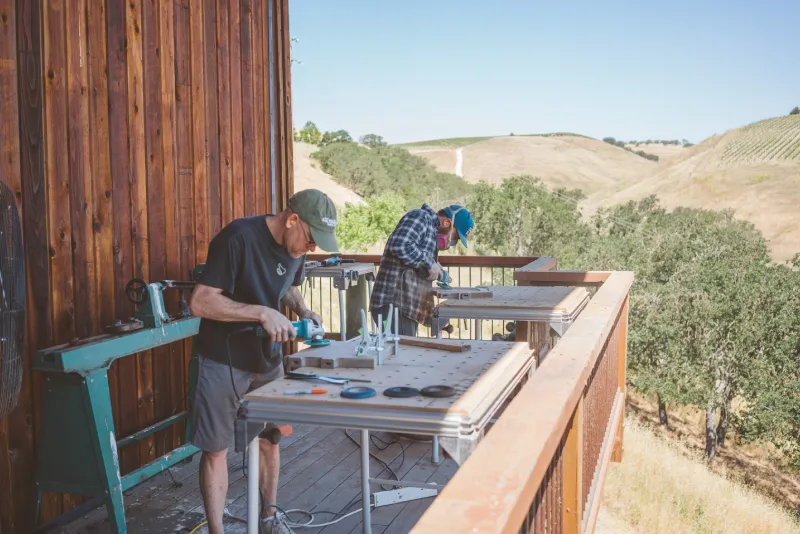
Jory Brigham Design Workshop operates at the intersection of serious instruction and a genuinely enjoyable experience. The workshop is based in Paso Robles — a setting that includes vineyard views, good food, and a community of people who share your interest. Courses run Friday through Sunday (the Hollister course runs Thursday through Sunday), with lodging available on-site and nearby.
Class sizes stay small: maximum eight participants for most courses, six for the Hollister and Emerson. Three instructors are present throughout. That ratio ensures you’re getting real feedback on what you’re actually doing, not just watching from a distance.
If you’ve been looking for modern woodworking classes that don’t talk down to you and actually trust you to build something challenging, take a look at the full course list and get in touch before the next date fills up.